
PTA for Companion Apps
Stop testing mobile apps in isolation. PTA unifies physical smartphones, vehicle BLE control units, cloud telematics (MQTT), and vehicle bus hardware into one closed-loop Robot Framework automation pipeline.
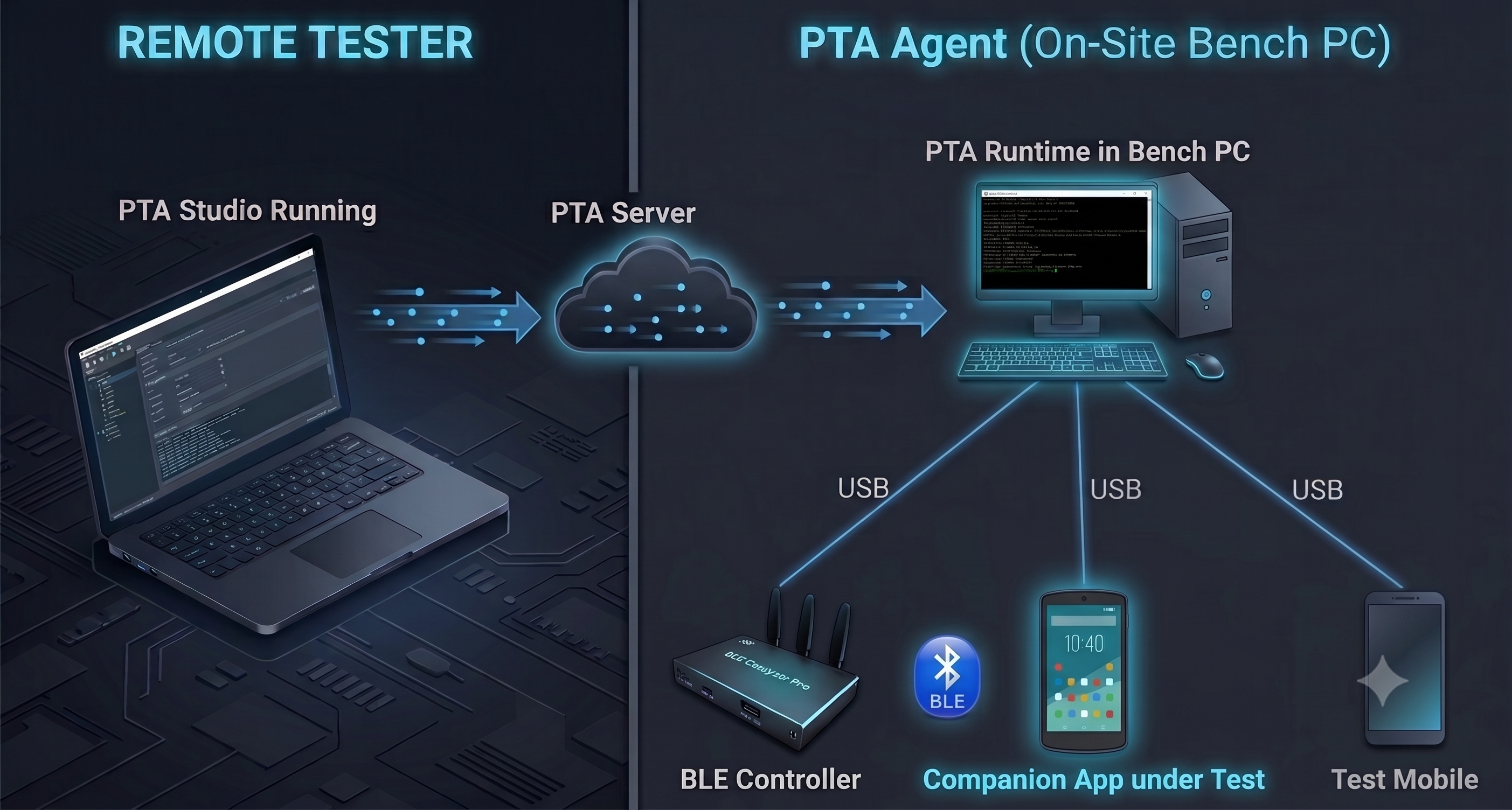
Closed-Loop Companion App Test Setup
Simultaneous verification across user touch interaction, wireless protocols, cloud brokers, and physical vehicle actuators.
⚠️ The Challenge: Why Appium Alone Is Not Enough
Standard mobile test frameworks only validate pixels on a phone screen. They operate in a silo and cannot verify whether:
- Tapping "Remote Unlock" or "Start Climate" on the smartphone actually transmitted the correct encrypted BLE advertisement or command payload to the vehicle.
- The Telematics Control Unit (TCU) received the cloud MQTT packet and properly asserted the door lock actuator or HVAC relay on the physical vehicle CAN bus.
- The Instrument Cluster or IVI display accurately synced battery state-of-charge (SOC), tire pressure, or trip telemetry back to the companion app within strict SLA requirements.
Core Companion App Test Domains
End-to-end automated coverage from low-level RF BLE signals to cloud telemetry synchronization.
BLE HIL Automation
- Programmable BLE Controllers: Interface with multi-channel BLE test racks to simulate vehicle beacon advertisements, RSSI signal attenuation, and key fob proximity.
- Proximity Entry & Walk-Away Lock: Programmatically control RF attenuation (RSSI) to validate passive keyless entry (PKE) and automatic walk-away locking without leaving the lab.
- Pairing & Bonding Resilience: Automate out-of-range signal drops, passkey authentication, bonded device switching, and reconnection latency under degraded radio conditions.
- BLE Protocol Conformance: Validate GATT service discovery, characteristic read/write/notify operations, and connection parameter updates.
Telematics & Cloud Sync (MQTT / REST)
- Bidirectional Command Verification: Trigger commands inside the companion app via Appium, verify outgoing MQTT packets on the cloud broker, and confirm physical execution on the vehicle CAN bus.
- Network Degradation Testing: Inject latency, packet loss, and connection timeouts to ensure the mobile app displays user-friendly retry banners and maintains offline queue integrity.
- Real-Time State Telemetry: Verify rapid synchronization of vehicle status, odometer readings, window/door lock states, TPMS tire pressure, and remote geofence alerts.
- Multi-Region Cloud Validation: Automate end-to-end authentication token lifecycle, OAuth2 refresh routines, and AWS IoT Core / Azure IoT Hub event processing.
Infotainment & Cluster Integration
- Turn-by-Turn (TBT) Navigation Sync: Route journeys on the companion app (Google Maps / Mapbox SDK) and verify navigation maneuvers, street names, distance remaining, and ETA sync accurately to the vehicle cluster via BLE/Wi-Fi.
- Media & Phone Integration: Validate that media playback controls, track metadata, album art, incoming calls, and contact lists synchronize smoothly between the test phone and the vehicle HMI.
- Push Notification Handover: Validate high-priority vehicle alarms, low battery warnings, intrusion alerts, and service reminders dispatched from cluster to companion app.
- Dual-Display State Consistency: Ensure settings changed on the mobile app (such as ambient lighting colors or drive mode presets) reflect immediately on the in-vehicle display.
EV Battery & Charging Management
- Battery SOC & Range Simulation: Simulate dynamic charging states, discharge curves, and cell thermal warnings over CAN bus.
- Charging Alerts & Notifications: Verify the companion app receives timely push notifications for charging started, charging interrupted, target SOC reached, and charging complete.
- Smart Climate Preconditioning: Test remote cabin temperature scheduling, defrost activation, and seat heater preconditioning against simulated HVAC sensor data.
- Charging Station Finder: Automate companion app POI routing, EVSE connector compatibility filters, and live station availability updates.
Features of PTA for Companion Apps
Comprehensive test capabilities engineered specifically for automotive OEM and Tier-1 mobile engineering teams.
UI/UX & Mobile Automation
Complete Appium-driven mobile gesture testing across iOS and Android test device matrices with OCR text verification and automated screenshot comparison.
IVI / Cluster Integration
Synchronized verification ensuring that mobile settings, profile preferences, and trip history align with digital cluster and IVI head unit states.
TCU & BLE Event Simulation
Full simulation of Telematics Control Unit (TCU) and vehicle BLE beacon transmissions without requiring a complete vehicle prototype.
MQTT Packet Simulation
Automated cloud broker validation verifying payload structure, encryption tokens, QoS delivery levels, and message broker failover.
CAN Simulation & Vehicle Info
Direct CAN signal injection verifying that physical vehicle sensors, speed, odometer, and warning lights update the mobile app in real-time.
Connectivity Regression Suite
Continuous regression sweeps for BLE/Wi-Fi connection recovery, background synchronization, flight mode toggles, and OS permission changes.
Ready to Automate Your Automotive Companion Apps?
Experience seamless, closed-loop testing across smartphones, cloud telematics, and vehicle bus hardware. Contact our automotive engineering team today.
Schedule a Technical Deep Dive →